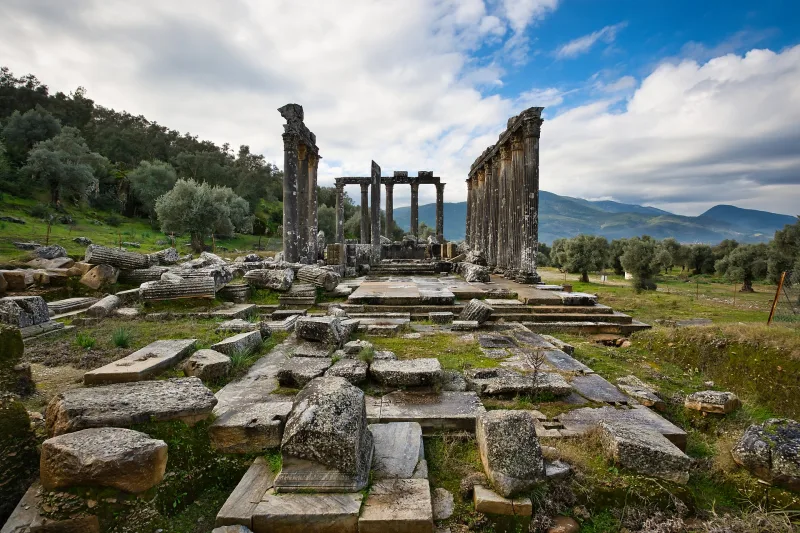
Euromus (Eurom) — the Temple of Zeus Lepsinus near Milas

Euromus: One of Turkey’s finest ancient temples

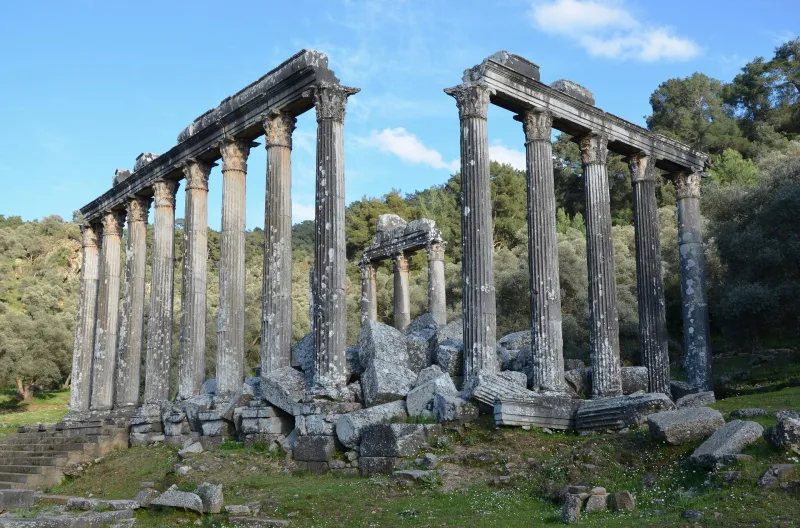
In a pine grove between the villages of Selimiye and Milas in the province of Muğla, right beside an old road, a sight suddenly comes into view that draws visitors here specifically: the Temple of Zeus Lepsynos—one of the best-preserved ancient temples in all of Turkey. Sixteen columns with capitals, a partially preserved entablature, and the clear rhythm of the Corinthian order in the morning sunlight—Euromos leaves the impression of an almost untouched ancient site, yet without crowds, lines, or noise. And it’s just 12 km northwest of Milas, on the route between Bodrum and Aphrodisias.

History and Origin

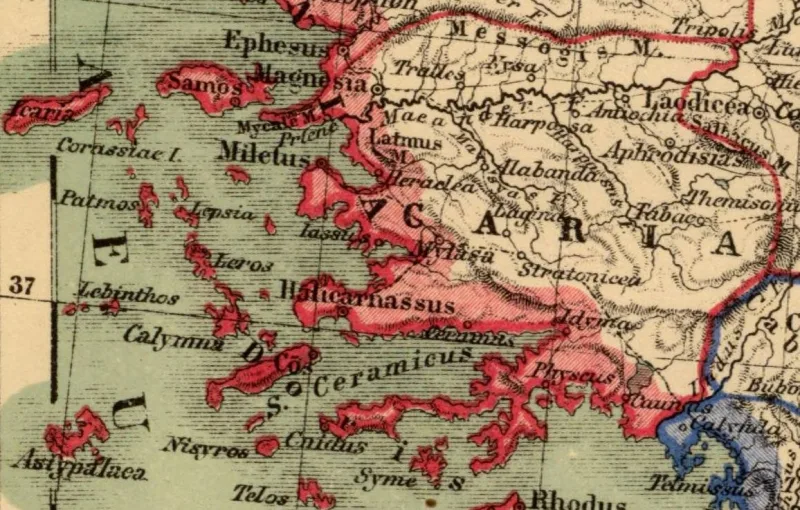
Euromos (or Euromos) is an ancient Carian city. According to legend, it was founded by Euromos, son of the Carian ruler Idris. Archaeological evidence indicates that a settlement has existed here since at least the 6th century BCE: terracotta shards and fragments of archaic pottery confirm this dating. The city was located at the foot of Mount Grium, parallel to the Latmus range.

During the Hellenistic period, Euromus was part of the Chrysorrhean League of Carian cities and wielded considerable influence. From the 2nd century BCE, it minted its own coins, a practice that continued for nearly four centuries—until the 2nd century CE. After the Roman conquest, the city became part of the conventus of Alabanda and remained inhabited until the Late Roman period.

The main structure at Euromus is the Temple of Zeus Lepsinus, built during the reign of Emperor Hadrian (2nd century CE). The epithet “Lepsinus” derives from the settlement’s earlier name, Lepsimandos. According to available data, the temple was erected on the site of an older sanctuary; the surviving part is a pseudo-dipteron of the Corinthian order with sixteen standing columns. Many of the columns bear inscriptions: the names of citizens and magistrates who paid for their installation (one of the earliest historical examples of “named” sponsorship of public architecture).

In 2021, a Turkish expedition led by Abuzer Kızıl announced the discovery of two marble statues dating back about 2,500 years and one inscription. One statue depicts a nude male figure, the other a figure in leather armor and a short skirt; both held lions in their hands. These finds point to a yet-undiscovered archaic sanctuary.

Architecture and What to See

Temple of Zeus Lepsinus

The main structure is a pseudo-dipteron with 6×11 columns along the perimeter (originally 36 columns). Today, sixteen columns remain, along with Corinthian capitals; some support the entablature. Extensive fragments of the cella have also survived. Several columns remain unfluted—a typical sign that construction was not fully completed. Epigraphic dedications by the city’s citizens are visible on the shafts of several columns.

The Theater, Agora, and Walls

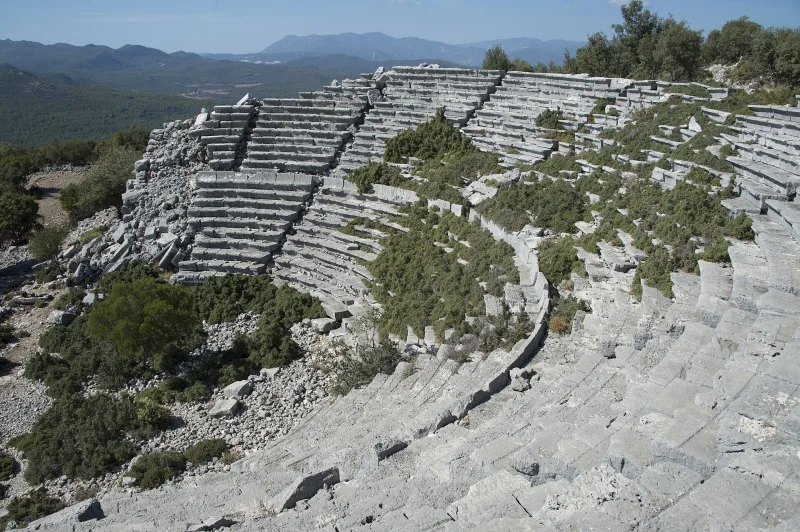
Behind the temple, deep within the grove, lies a theater—a small, Roman-era structure with seats partially overgrown with grass. The outlines of the agora, the foundation of the bouleuterion, and the remains of a defensive wall and several public buildings are also visible. These areas are less frequently visited by tourists, and one must follow a path through the forest to reach them.

Carian Rock Tombs

Carian rock tombs have been preserved in the cliffs near the city—burial chambers typical of the region, with facades carved into the cliff face. They offer insight into the pre-Hellenistic burial traditions of Caria.

Interesting Facts and Legends

  • The Temple of Zeus Lepsinus is one of the three best-preserved ancient temples in Turkey, along with the Temple of Athena in Aphrodisias and the temple in Aizanoi.
  • The unfluted columns are a rare feature: this means that the temple’s construction was never fully completed, and some of the columns remained with smooth shafts.
  • The names of citizens engraved on the columns turn the temple into a sort of “list of sponsors” from the Hadrianic era. Among them is a certain Menecrat—possibly the main donor for the reconstruction.
  • The name “Lepsinos” dates back to an earlier name for the city—Lepsimandos. This is an example of how a local Carian name was preserved in the epithet of a Greek god.
  • In 2021, Turkish archaeologists announced the discovery of two statues dating to around 500 BCE featuring figures holding lions—which points to an as-yet-unexcavated archaic sanctuary beneath the Roman ruins.

How to get there

Euromos is located 12 km northwest of Milas and 4 km southeast of Selimiye, in the province of Muğla. GPS coordinates: 37.374, 27.675. The nearest airport is Bodrum (BJV, Milas-Bodrum), about 25 km away. It takes less than an hour by car from Bodrum to Euromos via Highway D-330.

The “Euromos” sign is clearly visible right from the main road. The parking lot is small, but there’s always space. Public transportation: the Milas–Selimiye dolmuş passes by the excavation site; the stop is on request. It makes sense to combine this route with a trip through Caria: Labraunda (another sanctuary) — Euromos — IasosStratonikeia.

Tips for travelers

The best time to visit is spring and fall. In summer, there is shade among the pine trees and it’s relatively cool, but given the midday heat, it’s still better to arrive in the morning. The site is open in winter, but the dirt paths can be slippery when it rains.

It takes 30–40 minutes to tour the temple itself; a full walk around the site (theater, agora, tombs) takes about 1.5 hours. Shoes with good traction are recommended; water and a hat are essential. There is a modest ticket booth on the grounds; there is no café at the entrance—the nearest restaurants are in Selimiye and Milas.

Photographers should arrive at sunset: the sun sets between the columns from the west, and the pine tree backdrop creates particularly beautiful silhouettes. For epigraphy enthusiasts, we recommend printing out a map of the temple showing the location of the inscriptions in advance: many dedications are easy to miss if you don’t know where to look.
Your comfort is important to us, click on the desired marker to create a route.
Meeting for minutes before
Yesterday. 17:48
Frequently asked questions — Euromus (Eurom) — the Temple of Zeus Lepsinus near Milas Answers to frequently asked questions about Euromus (Eurom) — the Temple of Zeus Lepsinus near Milas. Information about the service's operation, capabilities, and use.
Euromus is an ancient Carian city in the province of Muğla, best known for the Temple of Zeus Lepsinus. It is one of the three best-preserved ancient temples in Turkey: sixteen columns with Corinthian capitals stand virtually intact. At the same time, the site is almost always uncrowded, there are no lines, and the atmosphere here is truly special—the ruins in a pine grove by the road make a strong impression.
There is a ticket booth on site; ticket prices are standard for state-run archaeological sites in Turkey. It is best to check the exact current price immediately before your trip on the official website of the Turkish Ministry of Culture or at local tourist offices, as rates are subject to change.
These are what are known as unfluted columns—their shafts remain smooth because the temple’s construction was never fully completed. This is a rare occurrence and makes Euromus a unique architectural monument: here, visitors can see what an unfinished ancient temple looked like and gain a better understanding of the construction process itself.
Inscriptions have been preserved on the shafts of several columns: the names of citizens and magistrates of Euromus who funded the erection of specific columns during the reign of Emperor Hadrian (2nd century CE). This is one of the earliest known examples of “named” sponsorship of public architecture—a unique list of patrons carved in stone. Among them is a certain Menecratus, presumably the principal donor for the construction.
In 2021, a Turkish expedition led by Abuzer Kızıl discovered two marble statues dating back about 2,500 years, along with an inscription. One statue depicts a nude male figure, the other a figure in armor wearing a short skirt; both were holding lions in their hands. The finds point to the existence of an unexcavated archaic sanctuary from the 6th–5th centuries BCE beneath the Roman ruins.
The Temple of Zeus Lepsinus in Euromus is considered one of the three best-preserved ancient temples in Turkey—along with the Temple of Athena in Aphrodisias and the temple in Aizanoi. The sixteen standing columns with their entablature represent an exceptionally high degree of preservation for the region.
Euromus is one of the oldest Carian cities: evidence of settlement dates back to the 6th century BCE. During the Hellenistic period, the city was part of the Chrysaorian League of Carian city-states. From the 2nd century BCE to the 2nd century CE, the city minted its own coins. After the Roman conquest, Euromus became part of the administrative district of the conventus of Alabanda and remained inhabited until the Late Roman period.
Yes, the site is much larger than it appears from the road. Behind the temple, deep within the grove, lies a small theater from the Roman era; the outlines of the agora, the foundations of the bouleuterion, and fragments of the defensive wall and public buildings are also visible. Carian rock-cut tombs with facades carved into the cliff face have been preserved in the nearby rocks. These areas are visited much less frequently—you have to reach them on foot via a forest trail.
Yes, although a car is more convenient. The shared minibus (dolmuş) from Milas toward Selimiye passes right by the excavation site—you can get off at any stop. The nearest airport is Bodrum (BJV, Milas-Bodrum), about 25 km away. By taxi or rental car, it takes less than an hour to get from Bodrum to Euromos via Highway D-330. The “Euromos” sign is clearly visible right from the road.
The most striking light is at sunset: the sun sets between the columns from the west, and the pine trees create a beautiful silhouette in the background. The morning light is also very nice and softer, making it ideal for photographing the details of the capitals and inscriptions. At midday in the summer, the light is harsh, though the shade from the pine trees provides some relief.
Euromus is a convenient stop on a tour of ancient Caria. A logical itinerary would be: Labraunda (the mountain sanctuary of Zeus, 14 km from Milas) — Euromus — Iasos (an ancient port city) — Stratonikeia. Aphrodisias and Bodrum can also be included in a one- or two-day tour of the region.
There is no café right at the entrance—only a small ticket booth. The nearest places to eat are in the villages of Selimiye (about 4 km away) and the town of Milas (about 12 km away). It is recommended that you bring water and a snack with you before your trip, especially during the summer.
User manual — Euromus (Eurom) — the Temple of Zeus Lepsinus near Milas Euromus (Eurom) — the Temple of Zeus Lepsinus near Milas User Guide with a description of the main functions, features, and principles of use.
Decide where you’re coming from. From Bodrum—it’s less than an hour by car or taxi on Highway D-330. From Milas—it’s about 15 minutes by car or dolmuş toward Selimiye, with stops on request. Coordinates: 37.374, 27.675. The “Euromos” sign is visible right from the main road; the parking lot is small but usually has available spots.
The best times to visit are spring and fall: pleasant temperatures, green pine trees, and soft light. In summer, come in the morning or closer to sunset—the midday heat can be intense, even though the pine grove provides shade. Sunset is especially good for photography: the sun sets between the columns from the west. The site is open in winter, but the dirt paths can be slippery after rain.
Wear comfortable shoes with good traction—the paths outside the temple grounds are uneven and wooded. Bring water and a hat: there is no café at the entrance. If you’re interested in epigraphy, print out or download a map of the temple showing the location of the inscriptions on the columns beforehand—many dedications are easy to miss without a guide. Check the admission price and hours of operation on the official website before your trip.
Start with the main feature—a pseudo-dipteral structure with sixteen standing Corinthian columns. Walk around the perimeter, noting the dedicatory inscriptions on the column shafts and the smooth (uncanneled) columns—evidence of unfinished construction. The surviving fragments of the entablature and cella are also clearly visible. A tour of the temple usually takes 30–40 minutes.
From the temple, follow the path deeper into the grove: there you will find a Roman-era theater with benches partially overgrown with grass, the outlines of the agora, the foundation of the bouleuterion, and fragments of the defensive wall. Be sure to check out the Carian rock-cut tombs in the nearby cliffs—they offer insight into the pre-Hellenistic burial traditions of Caria. Allow about 1.5 hours for a full tour of the site.
Euromus is easy to combine with other sites in a single day: the Labraunda mountain sanctuary (about 14 km from Milas), the port town of Iasos, and Stratonikeia form a logical loop route. Whether you’re coming from Bodrum or heading to Aphrodisias, Euromus fits naturally into your itinerary without requiring any major detours.